Innovation Management – How Companies Scale Innovation
Individual good ideas aren’t enough for success in the market. What companies need is the ability to generate innovation systematically and reproducibly. Innovation management is the framework that makes this possible.
Why Innovation Management Is a Core Topic for Companies
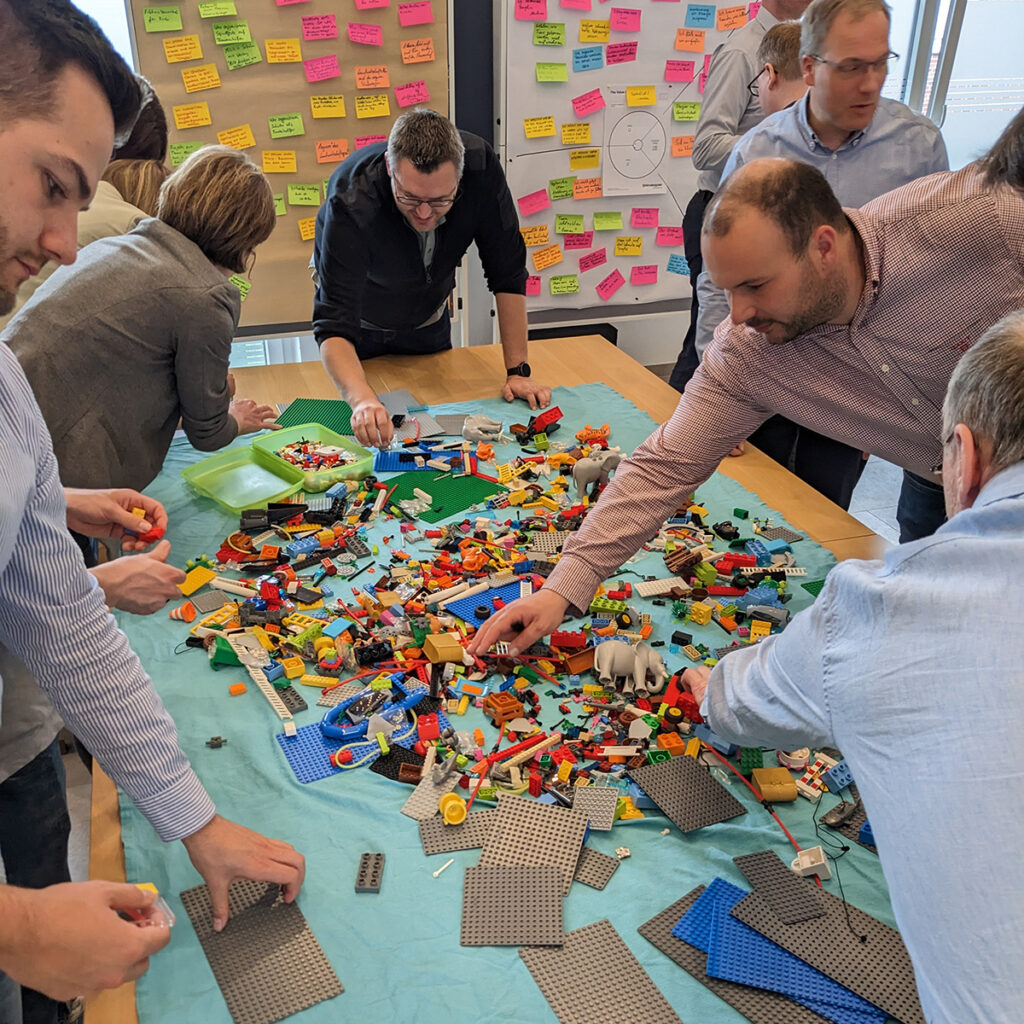
Innovation is not a product of chance. Companies that innovate consistently have developed structures for it: processes that systematically capture and evaluate ideas. Decision frameworks that distinguish between incremental improvement and genuine disruption. Resource models that create space for both.
Innovation management means deliberately designing and steering all of this — from idea generation through development to market launch. It means managing portfolios that balance different types of innovation. And it means keeping innovation processes capable of learning — because what works today needs to be adapted tomorrow.
The verrocchio Institute helps companies build and develop their innovation management — with a pragmatic approach that is oriented toward the reality of organizations, not toward academic ideal constructs.
Challenges We See in Companies Again and Again
Innovation is not structured, but accidental.
In many companies, innovation success depends on individual people or fortunate coincidences. There is no process that ensures good ideas are recognized, developed, and implemented. This makes innovation non-reproducible.
All innovations are treated the same.
Incremental product improvements and radical business model innovations need different processes, resources, and decision logics. Those who manage all innovation projects with the same instruments fail at both.
Stage-gate processes strangle early ideas.
Classical stage-gate models are designed for the later phases of innovation, when ideas have already been validated and made concrete. In early, uncertain exploration phases, they are counterproductive — they demand precision where openness is still what’s needed.
Innovation portfolios are not balanced.
Many companies invest almost exclusively in core innovation: small improvements to existing offerings. Adjacent and transformative innovations, which secure long-term competitiveness, are systematically underinvested.
Knowledge from innovation projects gets lost.
Projects end and the knowledge generated in the process disappears. What worked? What didn’t? Why? In most organizations there is no systematic learning loop that turns the experience of innovation projects into organizational intelligence.
How the verrocchio Institute Supports Innovation Management
The verrocchio Institute helps companies build, analyze, and develop their innovation management.
With more than 1,000 proven methods, a broad wealth of experience from more than 2,000 international projects, and a pragmatic approach that connects theory and practice.

Workshops for Systematic Innovation Management
→ Innovation Workshop: Experiencing innovation processes in practice and adapting them for your own organization. → Strategy Workshop: Strategically aligning and steering the innovation portfolio. → Design Thinking Workshop: Establishing user-centered development processes as part of innovation management. → AI Workshop: Developing AI-supported innovation management.
Impulses for Better Innovation Management
→ Keynotes by Christian Buchholz: Innovation, leadership, and AI for conferences and corporate events.
→ Keynotes by Benno van Aerssen: Strategy keynotes and The Art of Strategy.

Training Programs for Lasting Competency Development
For companies that want not just a one-time experience of innovation management but to anchor it durably in the organization, we offer the verrocchio Innovation Coach training programs as in-house programs. Developed by Christian Buchholz and Benno van Aerssen, awarded the International German Training Prize, and proven with more than 1,000 graduates.
All programs are delivered as in-house formats directly within your organization, adapted to your industry and starting situation.
Learning Nuggets from the verrocchio Academy
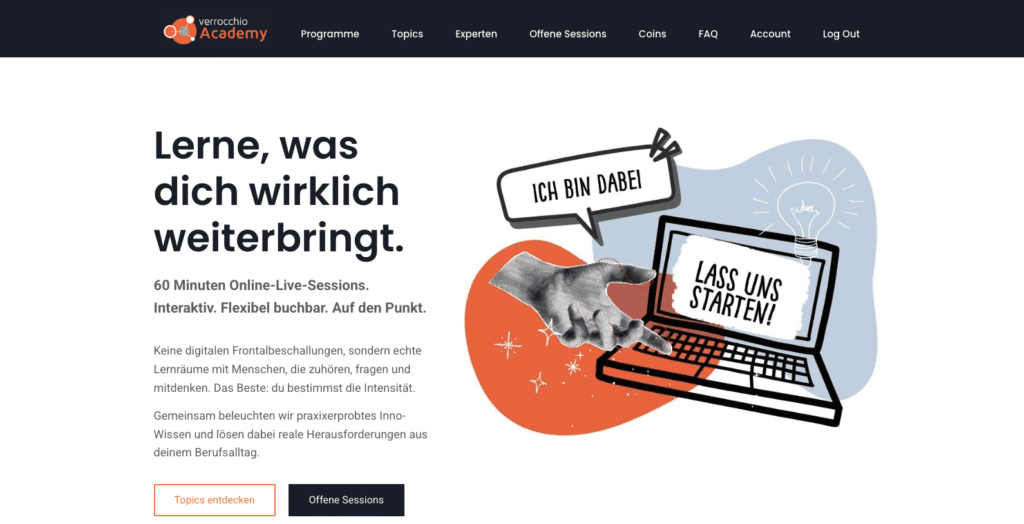
For targeted, modular learning, the verrocchio.academy is available. Content on innovation management from the training programs can be booked as Learning Nuggets: compact, directly applicable, without commitment to a complete program.
Innovation Management Knowledge — From Us, For You
The innovation.wiki contains more than 1,000 proven methods — including numerous approaches to structured innovation management. Two methods we use particularly often:
Three Horizons — a framework that structures innovation portfolios across three time horizons: optimizing the core business, opening up new fields, and preparing transformative innovations. The most important point: managing all three simultaneously.
Stage-Gate Model — a structured development process with clearly defined phases and decision points. Indispensable for the later phases of innovation — and to be applied deliberately, so as not to strangle early exploration phases.
The standard reference “The Innovator’s Dictionary” by Christian Buchholz and Benno van Aerssen: 555 innovation methods drawn from direct practical experience. → Learn more. → Order directly.
Get in Touch Now
Talk to us about your project, free of charge and with no obligation. In a 30-minute initial conversation, we’ll clarify where you currently stand, which format fits your situation, what a realistic scope looks like, and how we can move forward together.
Christina Westing will answer your inquiry personally and quickly.