Innovation Culture – Innovation Doesn't Just Happen; It Has to Be Made Possible
Many companies have innovation processes, innovation labs, and idea management systems. And yet genuinely new ideas rarely make it through. That’s usually not down to missing structures, but to the culture underneath them. What this means — and how the verrocchio Institute supports companies in addressing it.
Why Innovation Culture Is a Core Topic for Companies

Culture is what happens when nobody is watching. What employees actually do when there’s no directive telling them. This is where it’s decided which ideas get voiced and which ones stay inside people’s heads. Whether someone tries something new or sticks with what’s proven. All of this is culture — and it’s decisive for whether innovation genuinely happens in an organization.
Innovation culture cannot be introduced by decree. It emerges from the sum of leadership behavior, incentive systems, how mistakes are handled, communication habits, and shared convictions. Those who want to develop innovation culture need to understand all of these levels and deliberately shape them.
The verrocchio Institute helps organizations develop innovation culture as a real competency — not as a guiding value on the homepage, but as a lived practice in everyday working life.
Challenges We See in Companies Again and Again
Innovation gets delegated.
In many companies, innovation is the job of a specific department: the innovation lab, the R&D team, the digitalization officer. Everyone else feels “not responsible” for it. The result: innovation happens, but it doesn’t scale, because it isn’t embedded in everyone’s daily work.
Mistakes get punished instead of learned from.
How mistakes are handled is the clearest indicator of innovation culture. In organizations where mistakes have negative consequences, no risks are taken. Without a willingness to take risks, there is no real innovation — only optimization.
Leaders are the biggest brake on innovation.
Not because they want to be, but because their behavior shapes the culture of the company. Leaders who prioritize efficiency, don’t allow questions, and don’t tolerate experiments create a culture that reflects exactly that. Innovation culture begins with leadership behavior.
Ideas drain away without consequence.
Employees have ideas. They voice them, sometimes even through systems designed for this purpose. And then nothing happens. No feedback, no decision, no outcome. After a few such experiences, people stop contributing ideas.
Psychological safety is absent.
The willingness to share ideas, ask questions, admit mistakes, and try new things is directly connected to the sense of safety within a team. Psychological safety is not a soft variable — it is the prerequisite for any form of innovation.
Short-term pressure crowds out long-term thinking.
n day-to-day operations, the urgent always wins over the important. Innovation needs space, time, and attention — resources that are systematically scarce in efficiency-optimized organizations. Those who don’t create breathing room don’t create innovation.
How the verrocchio Institute Supports Innovation Culture
The verrocchio Institute helps companies shape innovation culture consciously — at the level of leadership, team, and organization.
With more than 2,000 international projects, a broad repertoire of methods, and a deep understanding of the dynamics that shape culture.

Workshops for Deliberate Culture Development
→ Innovation Workshop: Developing innovation culture through concrete shared experience. → Strategy Workshop: Anchoring innovation culture as a strategic goal. → Design Thinking Workshop: Introducing human-centered thinking as a cultural principle. → Future Workshop: Developing a relationship to the future that nourishes innovation culture.
Impulses for Good Innovation Culture
When innovation culture is to genuinely take root in an organization, what’s sometimes needed first is an impulse from outside. Christian Buchholz delivers keynotes that guide audiences into a different mindset — from managing what exists to embracing the joy of shaping what’s next. Overview of all keynote topics
Christina Westing makes innovation culture visible — literally. Using visualization methods, graphic recording, and the visualization workshop, she helps teams translate their shared values, attitudes, and goals into images. What a team can see as a picture lives longer than any mission statement document.

Training Programs for Lasting Competency Development
For companies that want not just a one-time experience of innovation culture but to anchor it durably in the organization, we offer the verrocchio Innovation Coach training programs as in-house programs. Developed by Christian Buchholz and Benno van Aerssen, awarded the International German Training Prize, and proven with more than 1,000 graduates.
All programs are delivered as in-house formats directly within your organization, adapted to your industry and starting situation.
Learning Nuggets from the verrocchio Academy
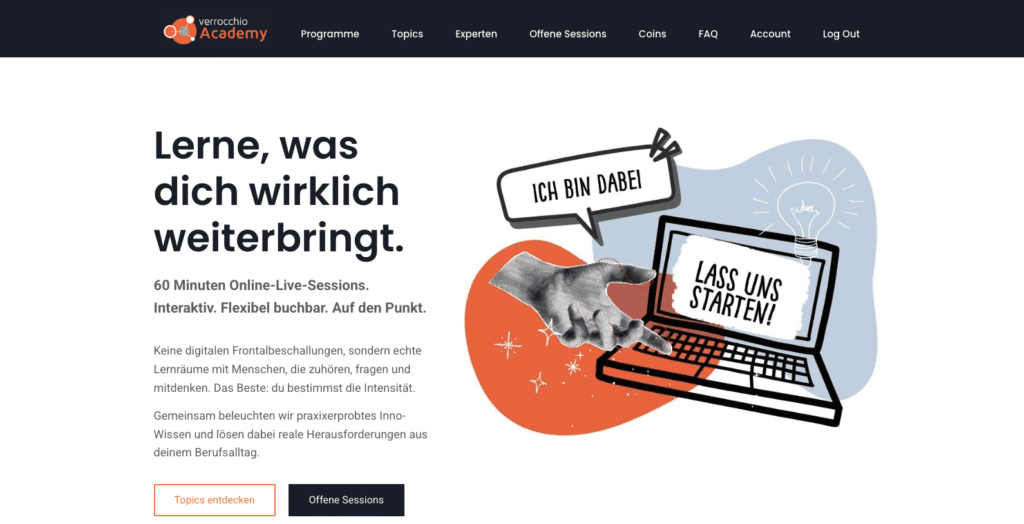
For targeted, modular learning, the verrocchio.academy is available. Content on innovation culture from the training programs can be booked as Learning Nuggets: compact, directly applicable, without commitment to a complete program.
Innovation Culture Knowledge — From Us, For You
The innovation.wiki contains more than 1,000 proven methods — including numerous approaches to developing innovation culture. Three methods we use particularly often:
Offering Activity Culture Map — a method that makes cultural patterns visible by systematically mapping the relationships between an organization’s offerings, activities, and cultural elements.
Retrospective — the most important tool for teams that want to learn: structured reflection on what went well, what didn’t, and what should be done differently next time. Psychological safety begins here.
Working Out Loud — an approach that anchors open working as a cultural principle: sharing knowledge, making progress visible, learning from one another — systematically and sustainably.
The standard reference “The Innovator’s Dictionary” by Christian Buchholz and Benno van Aerssen: 555 innovation methods drawn from direct practical experience. → Learn more. → Order directly.
Get in Touch Now
Talk to us about your project, free of charge and with no obligation. In a 30-minute initial conversation, we’ll clarify where you currently stand, which format fits your situation, what a realistic scope looks like, and how we can move forward together.
Christina Westing will answer your inquiry personally and quickly.