Artificial Intelligence & AI Competency – From Hype to Real Capability for Action
Many companies know that AI is coming. Very few know how to truly deal with it. The challenge is often not the technology itself, but the question of what human and strategic impact the use of AI actually has.
Why AI Competency Is a Core Topic for Companies
Artificial intelligence is changing business models, value chains, and working routines at a pace that overwhelms traditional planning cycles. What two years ago still sounded like a distant future is today already operational reality in many industries — or will be shortly. Language models, generative AI, autonomous agents: the technology wave is real, and it is hitting companies with varying degrees of preparedness.
What matters most is not the technology itself. It is the competency of the people who work with it. AI is not a purely IT topic. It is an organizational and strategic topic that redefines the collaboration between humans and machines. Employees who don’t understand AI can’t use it. Leadership teams that can’t situate AI strategically make the wrong decisions — or none at all.
For verrocchio, AI competency means both: the practical applied knowledge that enables teams to integrate AI meaningfully into their everyday work, and the strategic understanding that leadership teams need to use AI as a driver of innovation, not merely as an automation tool.
Challenges We See in Companies Again and Again
AI is being watched, but not used.
Many organizations find themselves in a wait-and-see position. Developments are tracked, individual tools get tested here and there, but structured deployment doesn’t happen. The result: while some employees use AI intensively in their private lives, organizational use remains fragmented and unreflective.
Competency is unevenly distributed.
In most organizations there is a small group that actively uses and understands AI, and at the same time a large majority that is falling behind. This competency gap grows with every new development. Without systematic competency building, it becomes a strategic risk.
Strategic orientation is missing.
Leadership teams are under pressure to make AI decisions without a clear picture of what AI actually means for their specific business model. What changes in the value chain? What stays human? What gets automated? Without answers to these questions, AI strategy remains theoretical.
The human factor is underestimated.
AI rollouts rarely fail because of the technology. They fail because of insufficient acceptance, unclear role assignments, and missing trust in new processes. Those who introduce AI without bringing people along create resistance instead of productivity.
Creativity and AI are seen as opposites.
A widespread misconception is that AI replaces creative work. In reality, AI changes how creative processes unfold and which human capabilities gain in importance as a result. Companies that combine AI and creativity have a considerable innovation advantage over those that keep the two separate.
Regulatory requirements are overwhelming.
The EU AI Act and growing compliance requirements confront companies with concrete questions: What are we allowed to deploy? What do we have to document? How do we design AI use responsibly? Without structured knowledge, this leads to overcaution — or, even more dangerously, to ignorance about actual risks.
Sustainability aspects are being ignored.
AI systems consume significant amounts of energy and resources. This aspect is left out of most AI discussions, even though it is relevant both for ESG reporting and for the strategic credibility of companies.
How the verrocchio Institute Supports AI
The verrocchio Institute helps companies build AI competency systematically — at the level of employees as much as at the level of strategy.
The foundation is the experience of more than 2,000 international projects and a methodological base that connects innovation, creativity, and strategic thinking. We don’t deliver tool descriptions. We build the capability to truly understand and use AI.
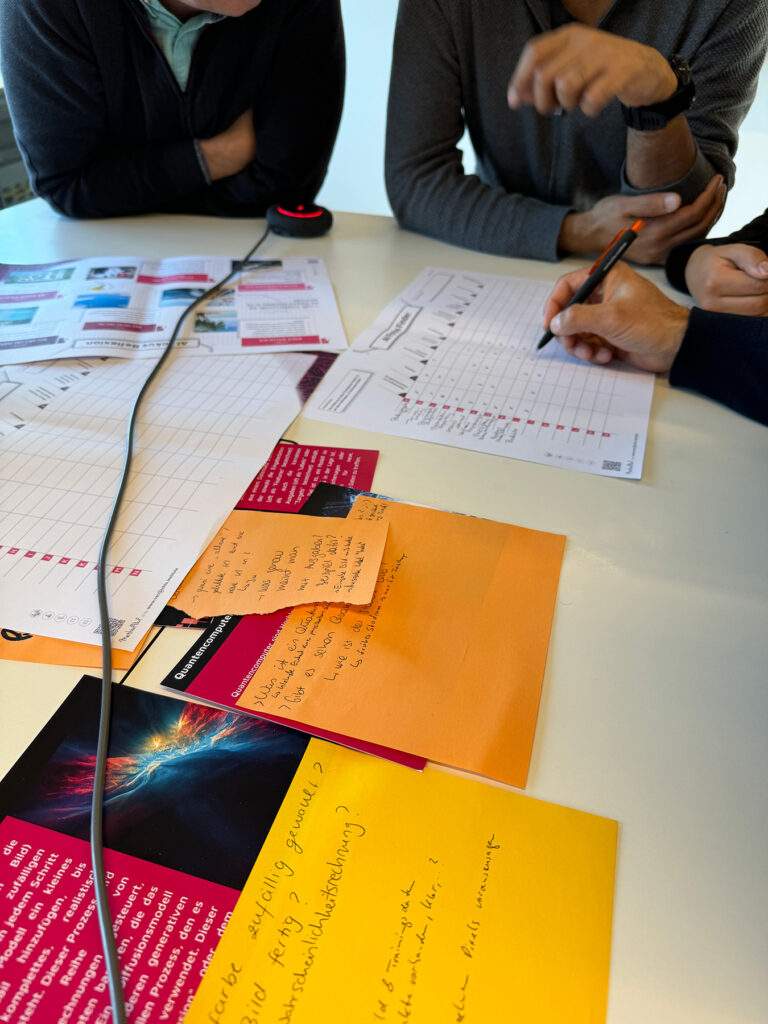
Workshops for Concrete Challenges
Depending on the starting point and goal, we work at different levels.
→ AI Workshop: Two formats depending on the target group — AI competency for teams, or AI and business model for leadership teams. → Innovation Workshop: When AI is to be integrated as an innovation driver into idea development. → Design Thinking Workshop: A user-centered perspective on AI-driven product and service development. → Strategy Workshop: Anchoring AI as a strategic variable in the company’s orientation. → Sustainability Workshop: Thinking AI and ESG together — realistically assessing opportunities and risks. → Future Workshop: Situating AI in the context of megatrends and scenarios.
AI as a Keynote Topic
For those who want to experience AI not only in a workshop but as an impulse for a larger event: Christian Buchholz, co-founder of the verrocchio Institute, delivers AI keynotes for companies and conferences — drawing on 700+ talks in 32 countries and a background in cognitive neuroscience.

Training Programs for Lasting Competency Development
For companies that want not just a one-time AI competency experience but to anchor it durably in the organization, we offer the verrocchio Innovation Coach training programs as in-house programs. Developed by Christian Buchholz and Benno van Aerssen, awarded the International German Training Prize, and proven with more than 1,000 graduates.
AI competency is a content focus in several modules — embedded in the broader context of innovation capability, strategic thinking, and creativity. All programs are delivered as in-house formats directly within your organization, adapted to your industry and starting situation.
Learning Nuggets from the verrocchio Academy
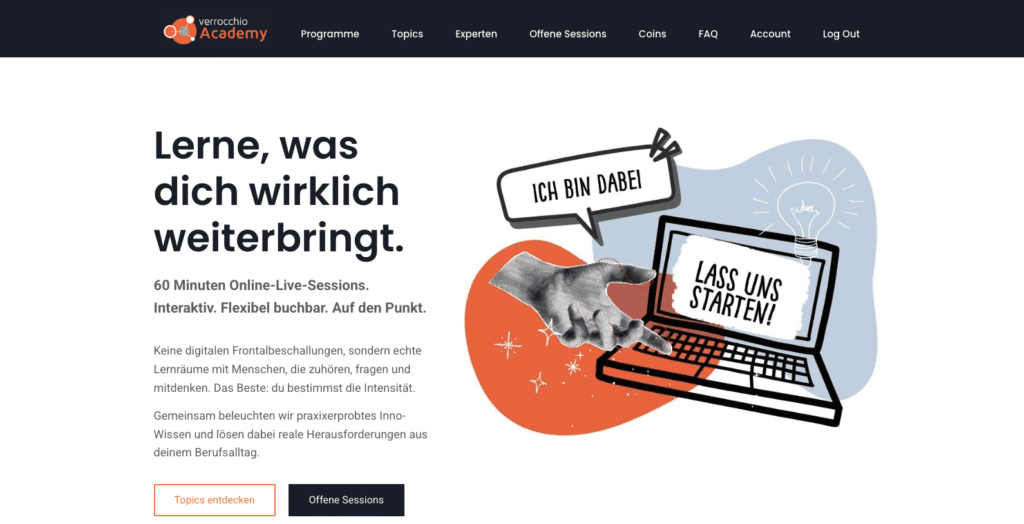
For targeted, modular learning exactly when it’s needed, the verrocchio.academy is available. AI content from the training programs can be booked as Learning Nuggets: compact, directly applicable, without commitment to a complete program. Ideal for teams building AI foundations, or for leaders who want to situate AI strategically — without going into technical depth.
AI Knowledge — From Us, For You
The innovation.wiki contains more than 1,000 proven methods — including a growing collection of AI-specific innovation methods for idea generation, scenario development, and strategic analysis. The world’s largest freely accessible methods database for innovation work, directly usable in your own practice.
Get in Touch Now
Talk to us about your project, free of charge and with no obligation. In a 30-minute initial conversation, we’ll clarify where you currently stand, which format fits your situation, what a realistic scope looks like, and how we can move forward together.
Christina Westing will answer your inquiry personally and quickly.