Future Readiness – Those Who Shape the Future Must First Understand It
Future readiness is more than resilience. It is the active capability of an organization not merely to survive change, but to shape it. What companies are currently facing in this regard — and how the verrocchio Institute supports them.
Why Future Readiness Is a Core Topic for Companies
The half-life of business models keeps shrinking. Technologies that were long considered stable are being replaced by new ones within a few years. Markets that offered security for decades are changing disruptively. Companies that only react to what is already visible arrive too late.
Future readiness means recognizing signals early, developing scenarios that map genuinely possible futures, and designing strategic decisions in ways that remain viable even under the pressure of change. We are talking about concrete competencies that can be developed in any organization.
Our co-founder Christian Buchholz calls the mindset required for this Zukunftsfreude: the inner conviction that change is not a risk to be managed, but a space for shaping that can be actively used. The verrocchio Institute translates this mindset into concrete methods and formats.
Challenges We See in Companies Again and Again
The future is understood as an extrapolation of the present.
Many strategy processes project what is known linearly into the future. What’s missing are genuine discontinuities — moments when something changes fundamentally. Those who only extend trends miss the changes that actually matter most.
Future forecasts are treated as an exercise, not as a basis for decisions.
Scenario work takes place, but the results end up on a shelf. What’s missing is the connection between possible futures and the concrete strategic decisions that need to be made today.
Change is experienced as a threat.
In many organizational cultures, a defensive relationship to the future dominates. Change means the unknown, the unknown means risk, risk means loss. This underlying attitude prevents organizations from actively shaping rather than reactively responding.
Weak signals go unnoticed.
Decisive changes usually announce themselves early — but quietly. Weak signals are not systematically captured in most organizations, because neither the sensitivity nor the processes for doing so exist.
AI as a future factor goes uncontextualized.
Artificial intelligence is changing the underlying conditions so rapidly that traditional future planning is outdated before it’s completed. Companies need formats that think of AI as a dynamic variable within future work.
Innovation - der wichtigste Wettbewerbsvorteil, den man lernen kann Was Unternehmen im Innovationskontext aktuell herausfordert und wie das verrocchio Institute dabei unterstützt. Warum Innovation für Unternehmen ein Kernthema ist Die Welt, in der Unternehmen wirtschaften, verändert sich schnellerpastedNun bitte das hier übersetzenInnovation – The Most Important Competitive Advantage You Can Learn What companies are currently facing in the context of innovation, and how the verrocchio Institute supports them. Why Innovation Is a Core Topic for Companies The world in which companies operate is changing faster than ever before. The half-life of successful business models is shrinking: what still held up a decade ago is under pressure today. New technologies, above all artificial intelligence, are transforming entire industries at a pace that overwhelms traditional planning cycles. At the same time, societal and regulatory demands around sustainability, the world of work, and corporate responsibility are growing. In this environment, innovation is no longer a strategic option that companies either have or don't have. It is an organizational survival competency. Companies that don't systematically invest in their innovation capability don't just lose market share in the short term. They lose the structural ability to adapt at all. The crucial point: innovation capability is not a talent that some companies have and others don't. It is a competency that can be built, through the right methods, the right structures, and the right mindset. Challenges We See in Companies Again and Again In our work with mid-sized companies and large corporations across more than 30 countries, we encounter the same recurring patterns. They are not exceptions. They are the rule. Day-to-day business leaves no room. Innovation needs time, energy, and focus — and all three are systematically consumed by operational demands. Projects that are supposed to deliver results lose out in everyday life to meetings that manage results. What isn't urgent doesn't get done, even when it's important. Ideas emerge, then disappear. Workshops happen, ideas get developed, and then nothing follows. There's no structure to turn creative impulses into concrete next steps. Post-its are often the only outcome. Innovation is either the CEO's job or nobody's job. Either innovation work depends on a single person or department — and therefore on their capacity and influence. Or it's so broadly distributed that no one actually takes responsibility. Neither works. A lack of methods slows implementation. Teams want to innovate but don't know how. Brainstorming is the default response to innovation challenges, and rarely the right one. Without methodological tools, creativity stays random. Cultural blockages operate invisibly. Error culture, psychological safety, hierarchical thinking: what goes unspoken in everyday life systematically prevents innovation. No one names it explicitly, but everyone feels it. Technological change is overwhelming. Many companies feel the pressure from artificial intelligence, automation, and new platform dynamics, but don't know where to sensibly begin or what the shift concretely means for their business model. Sustainability and innovation are kept separate. ESG requirements and innovation work run on separate tracks in many companies, even though it's precisely the connection between the two that holds the greatest strategic potential. Send an inquiry Schedule an initial conversation How the verrocchio Institute Supports Innovation The verrocchio Institute helps companies build innovation capability systematically — not with off-the-shelf standard programs, but tailored to the specific situation. The foundation is a pool of more than 1,000 proven innovation methods, documented on innovation.wiki, and the experience of 2,000+ international projects. We don't facilitate workshops just so workshops can be said to have happened. We work with you until the results truly hold up. Depending on the starting point and goal, we work at different levels. Workshops for Concrete Challenges When your team needs to reach actionable results quickly on a specific challenge, our workshop formats are the right entry point. Externally facilitated, methodologically grounded, with clear next steps as the outcome. → Innovation Workshop: Structured facilitation, practically grounded, with a prioritized idea pool and clear responsibilities as the result. → Design Thinking Workshop: Innovation thought from the user's perspective, not from the inside out. → AI Workshop: Building AI competency and aligning business models with AI. → Sustainability Workshop: Opening up sustainability as a source of innovation, not managing it as an obligation. → Strategy Workshop: Embedding innovation into the strategic direction of the company. → Future Workshop: Connecting innovation work with a view to scenarios and megatrends. Training Programs for Lasting Competency Development For companies that don't just want individual workshops but want to build internal innovation competency systematically and durably, we offer the verrocchio Innovation Coach training programs as in-house programs. Developed by Christian Buchholz and Benno van Aerssen, awarded the International German Training Prize, and proven with more than 1,000 graduates. The programs — Innovation Professional, Innovation Master, Innovation Facilitator, and Sustainable Innovator — build on one another and can be deployed depending on the depth and goal required. All are delivered as in-house formats directly within your organization, adapted to your industry and starting situation. Send an inquiry Schedule an initial conversation Learning Nuggets from the verrocchio Academy For targeted, modular learning exactly when it's needed, the verrocchio.academy is available. Individual topics from the training programs can be booked as Learning Nuggets: compact, directly applicable, without commitment to a complete program. Ideal for companies that want to embed innovation knowledge where it's actually relevant in everyday work, and for individuals who want to develop specific competencies in a focused way. Innovation Knowledge — From Us, For You Over the years we have discovered many methods, thought differently, and reinvented others. But there was no comprehensive reference work — so we created one. Our handbook gives you an extensive overview of 555 current innovation methods and tools, compiled by 11 authors directly from their practical work. It is a genuine treasure of real practical experience that will help you — whether beginner or expert — select methods quickly, confidently, and without dogma. Who Is It For? The handbook is suited to teams, companies, and individuals who engage with the topic of innovation, who want to deepen their existing knowledge of methods, or who are looking for inspiration to discover new ones. Learn more Order directly Get in Touch Now Talk to us about your project, free of charge and with no obligation. In a 30-minute initial conversation, we'll clarify where you currently stand, which format fits your situation, what a realistic scope looks like, and how we can move forward together. Christina Westing will answer your inquiry personally and quickly. Book a no-obligation initial conversation in Christina's calendar Send us a message Call us: +49 211 822 045 60Design Thinking – die Methode, die zuerst zuhört Viele Unternehmen investieren in Lösungen, bevor sie das Problem wirklich verstanden haben. Design Thinking kehrt diese Reihenfolge um. Was Unternehmen aktuell im Design-Thinking-Kontext herausfordert – und wie das verrocchio Institute dabei unterstütpastedBitte übersetzenDesign Thinking – The Method That Listens First Many companies invest in solutions before they've truly understood the problem. Design Thinking reverses this order. What companies are currently facing in the context of Design Thinking — and how the verrocchio Institute supports them. Why Design Thinking Is a Core Topic for Companies Innovations rarely fail because of missing ideas. They fail because ideas are developed past the people who are supposed to use them. Products that are technically impressive but that nobody really needs. Services that sound good internally but don't work externally. Business models that seem logical from the inside but have never genuinely sought out the customer's perspective. Design Thinking is the methodological counterproposal to all of this. It places the human being consistently at the center. The method, originally developed at Stanford University, is today one of the most powerful innovation methods for companies of every industry and size. For verrocchio, Design Thinking is not an isolated technique. It is a mindset that runs through all phases of innovation work: understand before you act. Test before you scale. Learn from what doesn't work. Challenges We See in Companies Again and Again Teams solve the wrong problem. The most common mistake in innovation work is not a lack of creativity but a wrong problem definition. Teams start with assumptions instead of observations. They work with what is known internally and miss what is actually relevant externally. The result: elaborate solutions for problems nobody had. The user comes at the end, not the beginning. In many development processes, the user is only consulted once the fundamental decisions have already been made. Feedback is gathered but rarely genuinely incorporated. This can get quite expensive: the later a wrong course is corrected, the more resources have already been invested. Creative methods are used without a process framework. Brainstorming, ideation sessions, creative workshops: many teams know individual methods but apply them without a structured context. What's missing is the framework that turns individual creative moments into a coherent development process. Design Thinking provides exactly that framework. Prototypes are seen as a sign of weakness. The willingness to test early and fast is underdeveloped in many corporate cultures. Ideas are deliberated internally for too long before they go out into the world. The idea of showing something unfinished meets resistance — yet this is the most effective way to prevent costly misdevelopment. Empathy is not seen as a business tool. Deep user understanding — through interviews, observation, empathy maps — is neither systematically gathered nor structured evaluated in many organizations. What is dismissed as "too soft" is in reality one of the hardest sources of information for reliable product decisions. Agility without empathy leads in the wrong direction. Many companies have introduced agile working methods, work in sprints, and deliver fast. But speed in the wrong direction is no advantage. Without a human-centered starting point, iterations emerge that keep getting better at doing the wrong thing. Send an inquiry Schedule an initial conversation How the verrocchio Institute Supports Design Thinking The verrocchio Institute helps companies actually apply Design Thinking. We don't teach theoretical foundations — we focus on operational application within your own innovation work. The foundation is a pool of more than 1,000 proven methods, documented on our innovation.wiki, and the experience of more than 2,000 international projects. Depending on the starting point and goal, we work at different levels. Workshops for Concrete Challenges When your team needs a user-oriented perspective on a specific challenge, our workshop formats are the right entry point. Facilitated, structured, with a validated solution approach as the outcome. → Design Thinking Workshop: From user understanding to a tested solution — in one or two days. → Innovation Workshop: When the focus is on broad idea generation, not just user-centeredness. → Strategy Workshop: Design Thinking as a tool in strategic decision-making processes. → AI Workshop: A user-centered perspective on AI-driven product and service development. → Future Workshop: Design Thinking combined with scenarios and megatrends. Formats for People with Prior Knowledge Design Thinking First Aid You need effective remedies for suboptimal conditions in your Design Thinking sprint or project? In this format, you'll learn first aid and life-saving measures for your Design Thinking projects. Get answers to the question: "What obstacles exist and how do we ideally deal with them so that our Design Thinking sprint or project can still become a success?" Design Thinking Is Not Everything "We love Design Thinking" — BUT not every challenge is well-suited to Design Thinking. That's why in this format we show you alternatives, complements, and combinations around Design Thinking. We show and work through real alternatives together with your team, compare different macro-methods, and develop adaptations and combinations. Design Thinking First Aid — In Detail Let's face reality: our Design Thinking sprints and projects almost never run under perfect conditions. In fact, it's entirely normal to have limiting factors in everyday working life. In this seminar you will learn: How to identify missing success parameters in your sprint or project What to do when you have too little time for the project What to do when your ideas can't be iterated and tested sufficiently How to respond to colleagues who are not participating in the project voluntarily How to handle experienced colleagues and managers in the project who think they know better Design Thinking Is Not Everything — In Detail Too often, Design Thinking is misused for lack of an alternative, applied in ways that don't serve the goal, or combined awkwardly with other methods. The problem is: once a method has fallen into disrepute in a company or team due to misapplication, nobody wants to work with it in the long run — and that has far-reaching consequences. In this seminar you will therefore get to know and apply alternative, compelling macro-methods, including: Creative Problem Solving Design Innovation Process Forth Innovation TRIZ Lean Startup Idealog Process Blue Ocean Strategy Wallas Creative Process Six Thinking Hats Training Programs for Lasting Competency Development For companies that don't just want to experience Design Thinking once but want to anchor it systematically in their organization, we offer the verrocchio Innovation Coach training programs as in-house programs. Developed by Christian Buchholz and Benno van Aerssen, awarded the International German Training Prize, and proven with more than 1,000 graduates. Design Thinking is a content focus in several of these training modules, from the fundamentals of human-centered thinking to advanced facilitator competencies. All programs are delivered as in-house formats directly within your organization, adapted to your industry and starting situation. Send an inquiry Schedule an initial conversation Learning Nuggets from the verrocchio Academy For targeted, modular learning exactly when it's needed, the verrocchio.academy is available. Individual topics from the training programs can be booked as Learning Nuggets: compact, directly applicable, without commitment to a complete program. Ideal for companies that want to embed innovation knowledge where it's actually relevant in everyday work, and for individuals who want to develop specific competencies in a focused way. Design Thinking Knowledge — From Us, For You Over 500 years of documented innovation knowledge, more than 1,000 proven methods, many of them drawn directly from Design Thinking practice: innovation.wiki is the world's largest freely accessible methods database for innovation work. Methods such as Empathy Mapping, Jobs-to-be-Done, How-Might-We, and Prototyping are fully documented there and immediately usable in your own work. We also recommend the standard reference "Das große Handbuch Innovation" by Christian Buchholz and Benno van Aerssen: 555 innovation methods drawn from direct practical experience — a reference work for everyone who wants to work with methods systematically and without dogma. Learn more | Order directly Our Free Design Thinking Tools Design Thinking QuickCheck The checklist from our seminar helps you reflect on the conditions for your next Design Thinking project or sprint more quickly and clearly, in order to increase the probability of success. To use the QuickCheck, please use the following form: First name * Last name * Email * Design Thinking Methods Check The check gives you fast and reliable help in reflecting on Design Thinking in relation to the challenge you need to solve. Is Design Thinking the right method, or should you consider alternatives? To use the Methods Check, please use the following form: First name * Last name * Email * Get in Touch Now Talk to us about your project, free of charge and with no obligation. In a 30-minute initial conversation, we'll clarify where you currently stand, which format fits your situation, what a realistic scope looks like, and how we can move forward together. Christina Westing will answer your inquiry personally and quickly. Book a no-obligation initial conversation in Christina's calendar Send us a message Call us: +49 211 822 045 60 More Knowledge and Inspiration on the Topic Read "What Is Design Thinking?" to learn about the origins of the method, its various variants, and helpful tools for applying it. To the article Read "Design Thinking with ChatGPT" to understand, through practical examples, how you can use ChatGPT in the Design Thinking process. To the article Read "What Is Agile Working, Really?" and learn what agility consists of and how you can support your employees in working more agilely. To the article Find more on innovation, transformation, and sustainability in the Innovation Navigator on innovation.wiki. Read now and gain new knowledge. Read more articlesKünstliche Intelligenz & KI-Kompetenz – vom Hype zur echten Handlungsfähigkeit Viele Unternehmen wissen, dass KI kommt. Die wenigsten wissen, wie sie wirklich damit umgehen sollen. Die Herausforderung ist dabei oft nicht die Technologie, sondern die Frage welche Auswirkungen der Einsatz von KI menscpastedÜbersetzenArtificial Intelligence & AI Competency – From Hype to Real Capability for Action Many companies know that AI is coming. Very few know how to truly deal with it. The challenge is often not the technology itself, but the question of what human and strategic impact the use of AI actually has. Why AI Competency Is a Core Topic for Companies Artificial intelligence is changing business models, value chains, and working routines at a pace that overwhelms traditional planning cycles. What two years ago still sounded like a distant future is today already operational reality in many industries — or will be shortly. Language models, generative AI, autonomous agents: the technology wave is real, and it is hitting companies with varying degrees of preparedness. What matters most is not the technology itself. It is the competency of the people who work with it. AI is not a purely IT topic. It is an organizational and strategic topic that redefines the collaboration between humans and machines. Employees who don't understand AI can't use it. Leadership teams that can't situate AI strategically make the wrong decisions — or none at all. For verrocchio, AI competency means both: the practical applied knowledge that enables teams to integrate AI meaningfully into their everyday work, and the strategic understanding that leadership teams need to use AI as a driver of innovation, not merely as an automation tool. Challenges We See in Companies Again and Again AI is being watched, but not used. Many organizations find themselves in a wait-and-see position. Developments are tracked, individual tools get tested here and there, but structured deployment doesn't happen. The result: while some employees use AI intensively in their private lives, organizational use remains fragmented and unreflective. Competency is unevenly distributed. In most organizations there is a small group that actively uses and understands AI, and at the same time a large majority that is falling behind. This competency gap grows with every new development. Without systematic competency building, it becomes a strategic risk. Strategic orientation is missing. Leadership teams are under pressure to make AI decisions without a clear picture of what AI actually means for their specific business model. What changes in the value chain? What stays human? What gets automated? Without answers to these questions, AI strategy remains theoretical. The human factor is underestimated. AI rollouts rarely fail because of the technology. They fail because of insufficient acceptance, unclear role assignments, and missing trust in new processes. Those who introduce AI without bringing people along create resistance instead of productivity. Creativity and AI are seen as opposites. A widespread misconception is that AI replaces creative work. In reality, AI changes how creative processes unfold and which human capabilities gain in importance as a result. Companies that combine AI and creativity have a considerable innovation advantage over those that keep the two separate. Regulatory requirements are overwhelming. The EU AI Act and growing compliance requirements confront companies with concrete questions: What are we allowed to deploy? What do we have to document? How do we design AI use responsibly? Without structured knowledge, this leads to overcaution — or, even more dangerously, to ignorance about actual risks. Sustainability aspects are being ignored. AI systems consume significant amounts of energy and resources. This aspect is left out of most AI discussions, even though it is relevant both for ESG reporting and for the strategic credibility of companies. Send an inquiry Schedule an initial conversation How the verrocchio Institute Supports AI The verrocchio Institute helps companies build AI competency systematically — at the level of employees as much as at the level of strategy. The foundation is the experience of more than 2,000 international projects and a methodological base that connects innovation, creativity, and strategic thinking. We don't deliver tool descriptions. We build the capability to truly understand and use AI. Workshops for Concrete Challenges Depending on the starting point and goal, we work at different levels. → AI Workshop: Two formats depending on the target group — AI competency for teams, or AI and business model for leadership teams. → Innovation Workshop: When AI is to be integrated as an innovation driver into idea development. → Design Thinking Workshop: A user-centered perspective on AI-driven product and service development. → Strategy Workshop: Anchoring AI as a strategic variable in the company's orientation. → Sustainability Workshop: Thinking AI and ESG together — realistically assessing opportunities and risks. → Future Workshop: Situating AI in the context of megatrends and scenarios. AI as a Keynote Topic For those who want to experience AI not only in a workshop but as an impulse for a larger event: Christian Buchholz, co-founder of the verrocchio Institute, delivers AI keynotes for companies and conferences — drawing on 700+ talks in 32 countries and a background in cognitive neuroscience. Learn more about Christian Buchholz's AI keynotes Training Programs for Lasting Competency Development For companies that want not just a one-time AI competency experience but to anchor it durably in the organization, we offer the verrocchio Innovation Coach training programs as in-house programs. Developed by Christian Buchholz and Benno van Aerssen, awarded the International German Training Prize, and proven with more than 1,000 graduates. AI competency is a content focus in several modules — embedded in the broader context of innovation capability, strategic thinking, and creativity. All programs are delivered as in-house formats directly within your organization, adapted to your industry and starting situation. Learning Nuggets from the verrocchio Academy For targeted, modular learning exactly when it's needed, the verrocchio.academy is available. AI content from the training programs can be booked as Learning Nuggets: compact, directly applicable, without commitment to a complete program. Ideal for teams building AI foundations, or for leaders who want to situate AI strategically — without going into technical depth. AI Knowledge — From Us, For You The innovation.wiki contains more than 1,000 proven methods — including a growing collection of AI-specific innovation methods for idea generation, scenario development, and strategic analysis. The world's largest freely accessible methods database for innovation work, directly usable in your own practice. Get in Touch Now Talk to us about your project, free of charge and with no obligation. In a 30-minute initial conversation, we'll clarify where you currently stand, which format fits your situation, what a realistic scope looks like, and how we can move forward together. Christina Westing will answer your inquiry personally and quickly. Book a no-obligation initial conversation in Christina's calendar Send us a message Call us: +49 211 822 045 60Zukunftsfähigkeit - wer die Zukunft gestaltet, muss sie zuerst verstehen Zukunftsfähigkeit ist mehr als Resilienz. Es ist die aktive Fähigkeit einer Organisation, Veränderung nicht nur zu überstehen, sondern zu gestalten. Was Unternehmen dabei aktuell herausfordert – und wie das verrocchio InstitutepastedÜbersetzenFuture Readiness – Those Who Shape the Future Must First Understand It Future readiness is more than resilience. It is the active capability of an organization not merely to survive change, but to shape it. What companies are currently facing in this regard — and how the verrocchio Institute supports them. Why Future Readiness Is a Core Topic for Companies The half-life of business models keeps shrinking. Technologies that were long considered stable are being replaced by new ones within a few years. Markets that offered security for decades are changing disruptively. Companies that only react to what is already visible arrive too late. Future readiness means recognizing signals early, developing scenarios that map genuinely possible futures, and designing strategic decisions in ways that remain viable even under the pressure of change. We are talking about concrete competencies that can be developed in any organization. Our co-founder Christian Buchholz calls the mindset required for this Zukunftsfreude: the inner conviction that change is not a risk to be managed, but a space for shaping that can be actively used. The verrocchio Institute translates this mindset into concrete methods and formats. Challenges We See in Companies Again and Again The future is understood as an extrapolation of the present. Many strategy processes project what is known linearly into the future. What's missing are genuine discontinuities — moments when something changes fundamentally. Those who only extend trends miss the changes that actually matter most. Future forecasts are treated as an exercise, not as a basis for decisions. Scenario work takes place, but the results end up on a shelf. What's missing is the connection between possible futures and the concrete strategic decisions that need to be made today. Change is experienced as a threat. In many organizational cultures, a defensive relationship to the future dominates. Change means the unknown, the unknown means risk, risk means loss. This underlying attitude prevents organizations from actively shaping rather than reactively responding. Weak signals go unnoticed. Decisive changes usually announce themselves early — but quietly. Weak signals are not systematically captured in most organizations, because neither the sensitivity nor the processes for doing so exist. AI as a future factor goes uncontextualized. Artificial intelligence is changing the underlying conditions so rapidly that traditional future planning is outdated before it's completed. Companies need formats that think of AI as a dynamic variable within future work. Send an inquiry Schedule an initial conversation How the verrocchio Institute Supports Future Readiness
The verrocchio Institute helps companies develop future readiness systematically — through scenario methods, strategic reflection, and the cultivation of a mindset that understands change as an opportunity.
Built on a foundation of more than 1,000 proven methods and 2,000+ international projects.
Workshops for Future-Ready Organizations
→ Future Workshop: Developing scenarios, situating megatrends, and setting strategic direction. → Strategy Workshop: Developing future readiness as a strategic framework. → Innovation Workshop: Systematically developing ideas for future business fields. → AI Workshop: Situating AI as a future factor strategically. → Sustainability Workshop: Shaping sustainable future readiness as a strategic goal.
Impulses on Zukunftsfreude
Christian Buchholz stands for the topic of Zukunftsfreude — the mindset of understanding change as a space for shaping rather than a threat. His keynotes on innovation, AI, and the future combine strategic clarity with genuine inspiration. Overview of all keynote topics
Benno van Aerssen complements this perspective with his framework The Art of Strategy: strategy as a dynamic, multi-layered craft for volatile markets. Learn more about The Art of Strategy
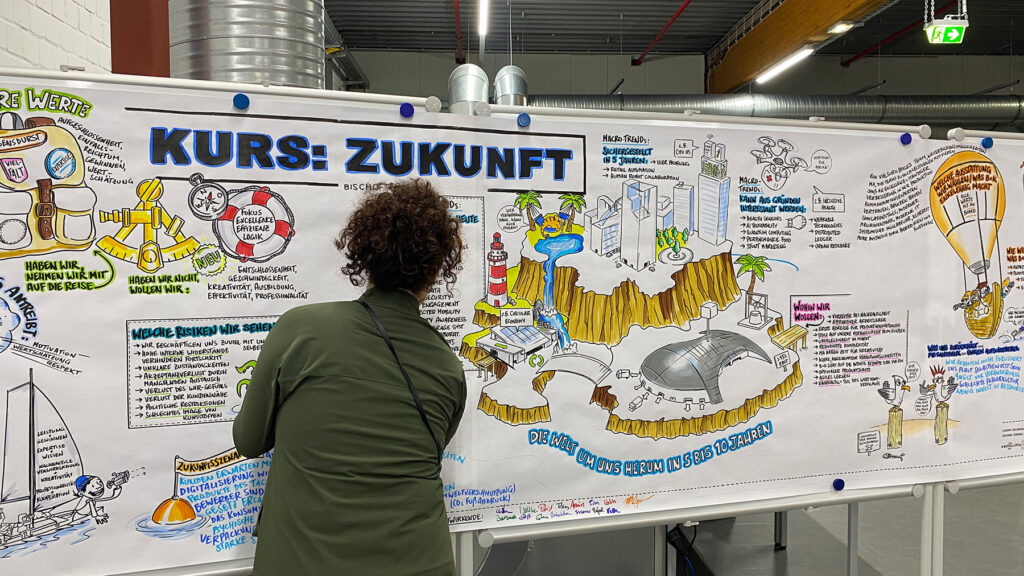
Christina Westing accompanies future processes as a visualization specialist who makes future images and scenarios visible. What emerges as an idea in the room becomes, through her work, something that teams can still see, share, and develop further long afterward. Learn more about Christina Westing

Training Programs for Lasting Competency Development
For companies that want not just a one-time experience of future readiness but to anchor it durably in the organization, we offer the verrocchio Innovation Coach training programs as in-house programs. Developed by Christian Buchholz and Benno van Aerssen, awarded the International German Training Prize, and proven with more than 1,000 graduates.
All programs are delivered as in-house formats directly within your organization, adapted to your industry and starting situation.
Learning Nuggets from the verrocchio Academy
For targeted, modular learning, the verrocchio.academy is available. Content on future readiness from the training programs can be booked as Learning Nuggets: compact, directly applicable, without commitment to a complete program.
Future Readiness Knowledge — From Us, For You
The innovation.wiki contains more than 1,000 proven methods — including numerous approaches to scenario work and future shaping. Three methods we use particularly often:
Future Scenarios Gallery with Scenario Map — structured scenario work for VUCA contexts: teams develop multiple possible futures and derive robust strategic decisions from them.
Newspaper Article from the Future — teams write a fictional newspaper article from the future, developing in this way a shared, concrete picture of where the journey should lead.
Future Workshop Method — a participative method developed by Robert Jungk that connects critique, utopia, and implementation in three phases, particularly suited to complex societal and organizational future questions.
The standard reference “The Innovator’s dictionary” by Christian Buchholz and Benno van Aerssen: 555 innovation methods drawn from direct practical experience. → Learn more. → Order directly.
Get in Touch Now
Talk to us about your project, free of charge and with no obligation. In a 30-minute initial conversation, we’ll clarify where you currently stand, which format fits your situation, what a realistic scope looks like, and how we can move forward together.
Christina Westing will answer your inquiry personally and quickly.