Design Thinking – The Method That Listens First
Many companies invest in solutions before they’ve truly understood the problem. Design Thinking reverses this order. What companies are currently facing in the context of Design Thinking — and how the verrocchio Institute supports them.
Why Design Thinking Is a Core Topic for Companies
Innovations rarely fail because of missing ideas. They fail because ideas are developed past the people who are supposed to use them. Products that are technically impressive but that nobody really needs. Services that sound good internally but don’t work externally. Business models that seem logical from the inside but have never genuinely sought out the customer’s perspective.
Design Thinking is the methodological counterproposal to all of this. It places the human being consistently at the center. The method, originally developed at Stanford University, is today one of the most powerful innovation methods for companies of every industry and size.
For verrocchio, Design Thinking is not an isolated technique. It is a mindset that runs through all phases of innovation work: understand before you act. Test before you scale. Learn from what doesn’t work.

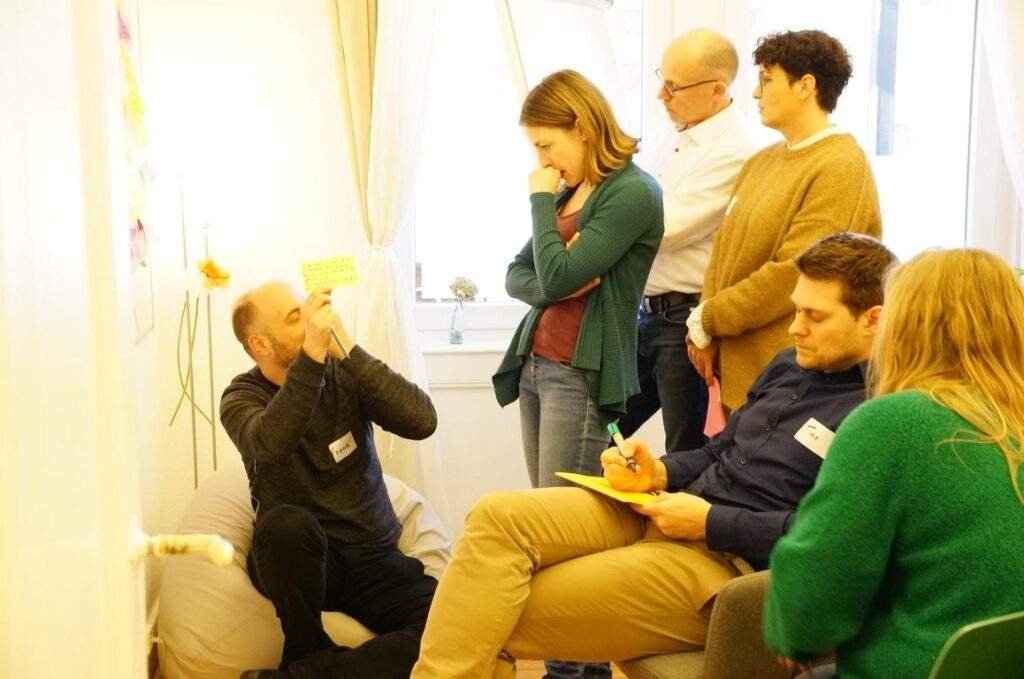
Challenges We See in Companies Again and Again
Teams solve the wrong problem.
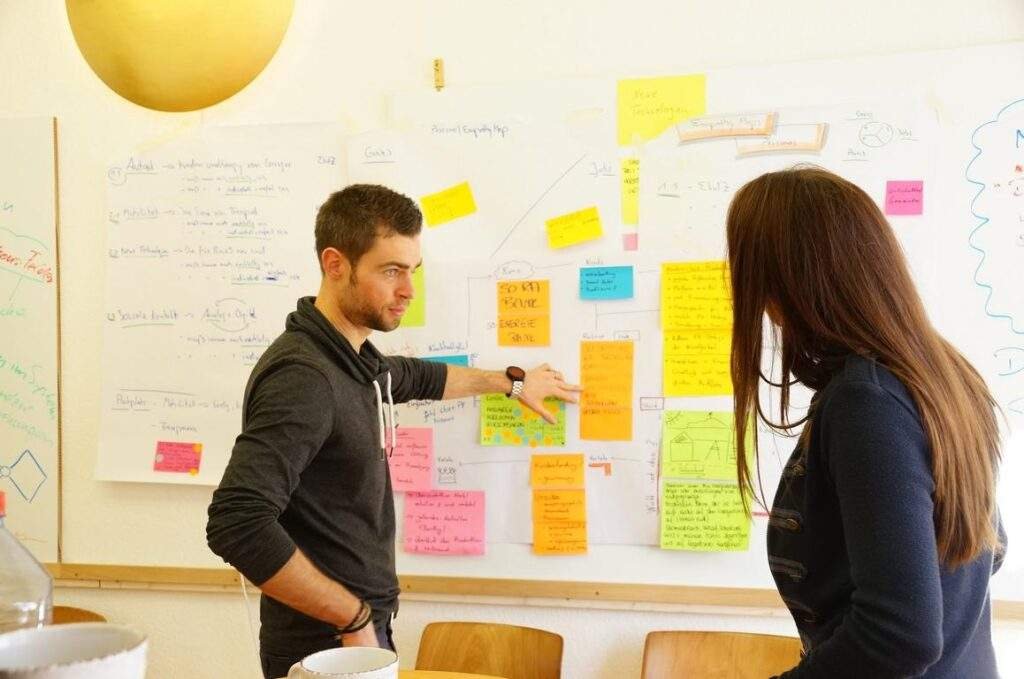
The most common mistake in innovation work is not a lack of creativity but a wrong problem definition. Teams start with assumptions instead of observations. They work with what is known internally and miss what is actually relevant externally. The result: elaborate solutions for problems nobody had.
The user comes at the end, not the beginning.
In many development processes, the user is only consulted once the fundamental decisions have already been made. Feedback is gathered but rarely genuinely incorporated. This can get quite expensive: the later a wrong course is corrected, the more resources have already been invested.
Creative methods are used without a process framework.
Brainstorming, ideation sessions, creative workshops: many teams know individual methods but apply them without a structured context. What’s missing is the framework that turns individual creative moments into a coherent development process. Design Thinking provides exactly that framework.
Prototypes are seen as a sign of weakness.
The willingness to test early and fast is underdeveloped in many corporate cultures. Ideas are deliberated internally for too long before they go out into the world. The idea of showing something unfinished meets resistance — yet this is the most effective way to prevent costly misdevelopment.
Empathy is not seen as a business tool.
Deep user understanding — through interviews, observation, empathy maps — is neither systematically gathered nor structured evaluated in many organizations. What is dismissed as “too soft” is in reality one of the hardest sources of information for reliable product decisions.
Agility without empathy leads in the wrong direction.
Many companies have introduced agile working methods, work in sprints, and deliver fast. But speed in the wrong direction is no advantage. Without a human-centered starting point, iterations emerge that keep getting better at doing the wrong thing.
How the verrocchio Institute Supports Design Thinking
The verrocchio Institute helps companies actually apply Design Thinking. We don’t teach theoretical foundations — we focus on operational application within your own innovation work.
The foundation is a pool of more than 1,000 proven methods, documented on our innovation.wiki, and the experience of more than 2,000 international projects. Depending on the starting point and goal, we work at different levels.
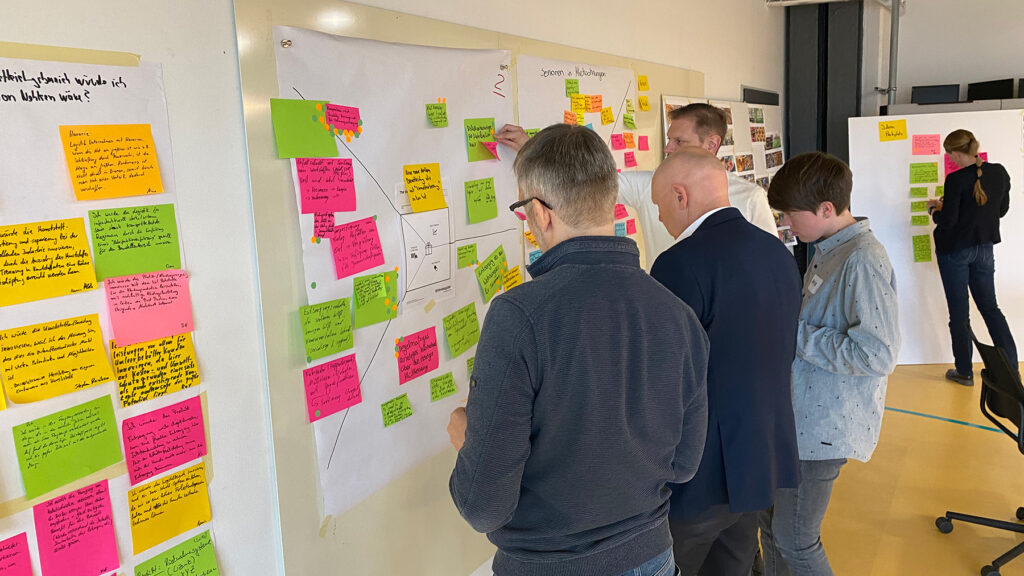
Workshops for Concrete Challenges
When your team needs a user-oriented perspective on a specific challenge, our workshop formats are the right entry point. Facilitated, structured, with a validated solution approach as the outcome.
→ Design Thinking Workshop: From user understanding to a tested solution — in one or two days. → Innovation Workshop: When the focus is on broad idea generation, not just user-centeredness. → Strategy Workshop: Design Thinking as a tool in strategic decision-making processes. → AI Workshop: A user-centered perspective on AI-driven product and service development. → Future Workshop: Design Thinking combined with scenarios and megatrends.
Formats for People with Prior Knowledge
Design Thinking First Aid
Need effective antidotes to suboptimal conditions in your Design Thinking sprint or project? In this format, you will learn first aid and life-saving measures for your Design Thinking projects.
Get solutions to the question, “What are the obstacle effects and how do we ideally deal with them so that our Design Thinking Sprint / Project can be a success after all?”
Design thinking is not everything
“We love Design Thinking” – BUT not all challenges can be solved well with Design Thinking. Therefore, in this format we show you alternatives, additions and combinations around Design Thinking.
Together with your team, we show and develop real alternatives, compare different macro methods and work out adaptations and combinations.
You are currently viewing a placeholder content from Vimeo. To access the actual content, click the button below. Please note that doing so will share data with third-party providers.
More InformationYou are currently viewing a placeholder content from Vimeo. To access the actual content, click the button below. Please note that doing so will share data with third-party providers.
More InformationDesign Thinking First Aid
Let’s face reality – our Design Thinking sprints and projects usually never run under perfect conditions. It is even the normality that we always have some limiting factors in our everyday work.
In the seminar you will therefore learn …
- How to identify missing success parameters of your sprint or project
- What you can do if you have too little time for the project
- What you can do if your ideas cannot be iterated and tested sufficiently
- How to respond to colleagues who do not voluntarily participate in the project
- How to deal with experienced colleagues and supervisors in the project who know better
Design thinking isn't everything
All too often, design thinking is misused due to a lack of alternatives, it is not adapted appropriately or is combined with other methods in an unfortunate way.
The problem is that once a method has fallen into disrepute in a company or team due to incorrect application, nobody wants to work with it in the long term – and this has far-reaching consequences.
In the seminar, you will therefore learn about and apply alternative, exciting macro methods. Among them:
- Creative Problem Solving
- Design Innovation Process
- Forth Innovation
- TRIZ
- Lean Startup
- Idealog Prozess
- Blue Ocean Strategy
- Creative process by Wallas
- 6 thinking hats
Training Programs for Lasting Competency Development
For companies that don’t just want to experience Design Thinking once but want to anchor it systematically in their organization, we offer the verrocchio Innovation Coach training programs as in-house programs. Developed by Christian Buchholz and Benno van Aerssen, awarded the International German Training Prize, and proven with more than 1,000 graduates.
Design Thinking is a content focus in several of these training modules, from the fundamentals of human-centered thinking to advanced facilitator competencies. All programs are delivered as in-house formats directly within your organization, adapted to your industry and starting situation.
Learning Nuggets from the verrocchio Academy
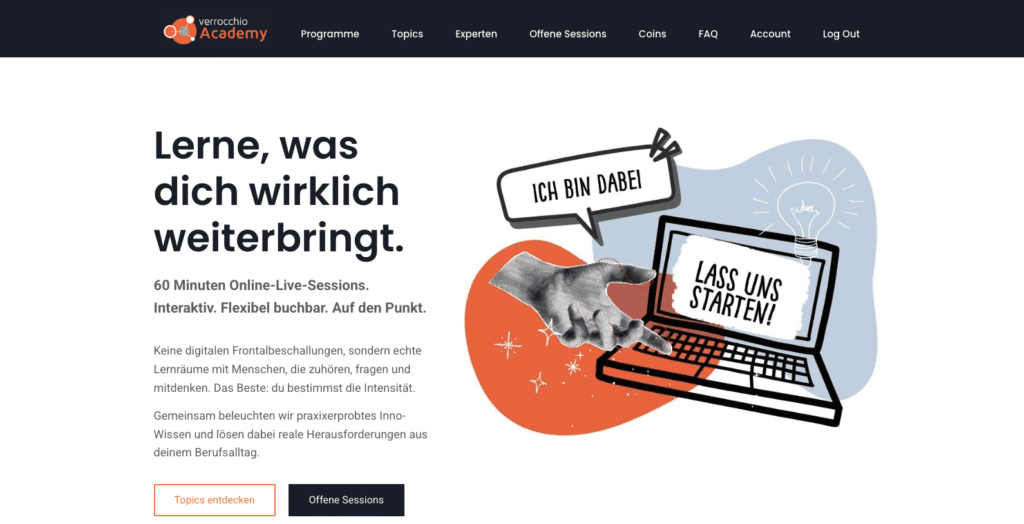
For targeted, modular learning exactly when it’s needed, the verrocchio.academy is available. Individual topics from the training programs can be booked as Learning Nuggets: compact, directly applicable, without commitment to a complete program. Ideal for companies that want to embed innovation knowledge where it’s actually relevant in everyday work, and for individuals who want to develop specific competencies in a focused way.
Design Thinking Knowledge — From Us, For You
Over 500 years of documented innovation knowledge, more than 1,000 proven methods, many of them drawn directly from Design Thinking practice: innovation.wiki is the world’s largest freely accessible methods database for innovation work. Methods such as Empathy Mapping, Jobs-to-be-Done, How-Might-We, and Prototyping are fully documented there and immediately usable in your own work.
We also recommend the standard reference “The Innovators’s dictionary” by Christian Buchholz and Benno van Aerssen: 555 innovation methods drawn from direct practical experience — a reference work for everyone who wants to work with methods systematically and without dogma. Learn more | Order directly
Our Free Design Thinking Tools
Get in Touch Now
Talk to us about your project, free of charge and with no obligation. In a 30-minute initial conversation, we’ll clarify where you currently stand, which format fits your situation, what a realistic scope looks like, and how we can move forward together.
Christina Westing will answer your inquiry personally and quickly.

More Knowledge and Inspiration on the Topic

Read “What is Design Thinking?” to learn about the origins of the method, different variations, and helpful tools for use.

Read “Design Thinking with ChatGPT” to understand how you can use ChatGPT in the design thinking process through use cases.

Read “What is agile really?” and learn what agile is all about and how to help your employees work more agilely.
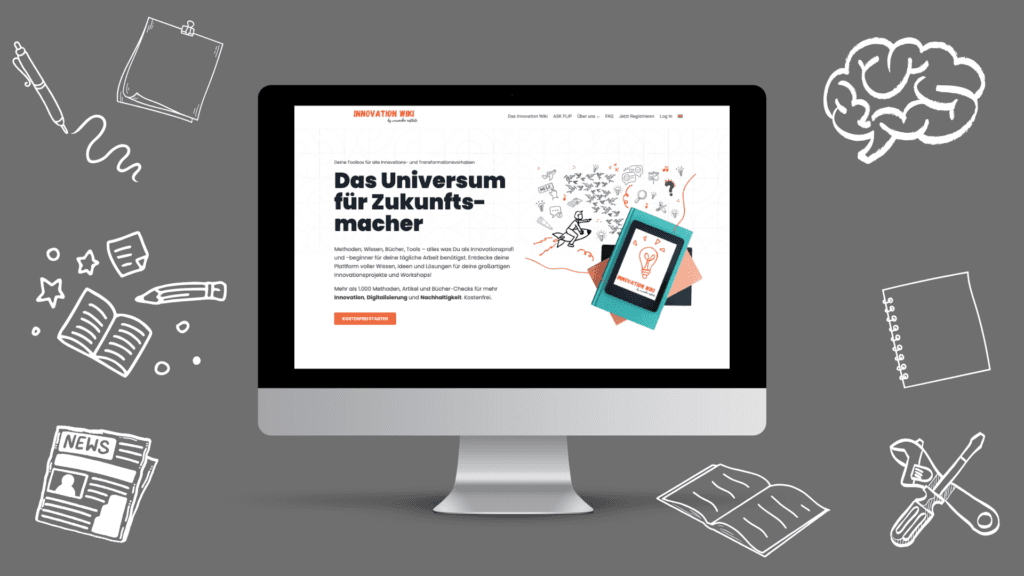
Find out more about innovation, transformation and sustainability in the Innovation Navigator on Innovation.Wiki. Read now and acquire new knowledge.